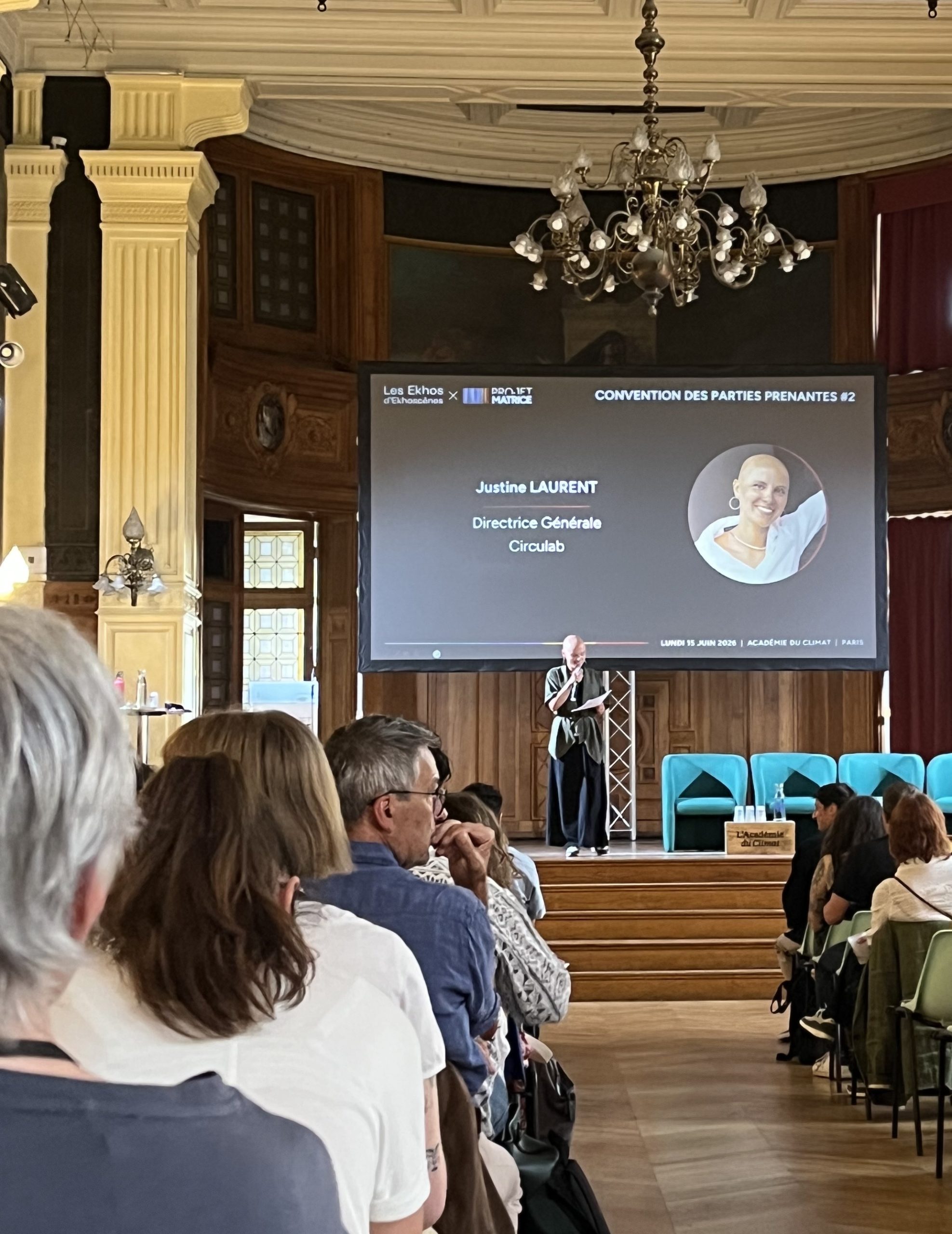
Below is the joint interview given by Justine Laurent, CEO of Circulab, and Laure Dubos, Director of Sport, Training, and Ecological Transition at UCPA (Union nationale des Centres sportifs de Plein Air), excerpted from the 2025 annual report – available at this link (in French).
“As environmental pressures intensify—particularly with regard to climate change, biodiversity loss, and pollution—the sports sector finds itself at a historic turning point. How can we maintain access to sport, protect natural playing fields, and transform practices without giving up leisure, holidays, and wellbeing?
To shed light on these issues, we brought together the perspectives of Justine Laurent, CEO of Circulab and an expert in circular models, and Laure Dubos, Director of Sport, Training, and Ecological Transition at UCPA. Two complementary visions for imagining a sport that is resilient, responsible, and that strengthens our connection to the living world.

Justine Laurent on the left. Laure Dubos on the right.
What are the strongest signals today showing that the sports sector needs to accelerate its ecological transition? And what major transformations does this imply?
Laure Dubos : The urgency is first and foremost tangible on the ground, for UCPA and no doubt for other players too. The effects of climate change are directly impacting the environments where sport takes place: more unpredictable snow cover in the mountains, coastal erosion, restricted access to certain natural sites, high summer temperatures… These changes are undermining access to sport and forcing us to plan ahead. That’s why we’ve launched climate vulnerability assessments at our sites, in order to adapt our facilities and activities. Ecological transition is no longer just a strategic choice—it’s a condition for the continuity of our mission.
Justine Laurent : The urgency is also economic and social. Today’s sports models are highly dependent on energy, space, and natural resources. But these resources are becoming scarcer. A finished product can require up to 70 times its own weight in virgin resources: that’s not sustainable in the long run. If we carry on this way, costs will skyrocket and these models will become socially exclusionary. At the same time, individual expectations are shifting: the relationship to nature and environmental impact has become central for many people who practice sport. This calls for a deep transformation of these models, not just minor adjustments.
What levers make it possible to genuinely rethink sports models, from infrastructure to usage?
Justine Laurent : The circular economy offers three major levers. First, acting on products and equipment: sufficiency, reuse, rental, sharing, modularity. Second, transforming business models, particularly in supplier relationships, by favoring cooperation and pooling resources. Third, thinking about value chains at the territorial scale in order to shorten flows and share resources. One very concrete example is the repair bonus for sports equipment: it encourages extending a product’s lifespan rather than replacing it, with an immediate economic benefit for the people using it.
Laure Dubos : These levers translate into very operational choices made by our teams. We’re working on extending equipment lifespans, repair, reuse, and secondhand options—particularly in cycling, surfing, diving, and boating, for example through joining a boat hull recycling network. For buildings, we’re incorporating sufficiency principles from the design stage onward, such as natural ventilation and modular spaces. Finally, in terms of usage, our collective model already allows us to pool equipment and limit overconsumption. The challenge now is to scale these practices systematically.
How can all stakeholders be concretely mobilized around the ecological transformation of sports practices?
Laure Dubos : UCPA sports instructors first draw on lived experience. Sports practice is a powerful lever for shifting mindsets and strengthening our connection to nature. We equip our instructors so that, through their own experience and field expertise, they can pass on messages related to our connection with the living world, sufficiency, and respect for natural environments. This also involves structural choices: making reusable water bottles standard, expanding vegetarian meal options, and raising awareness about animal welfare. There is resistance to change, particularly around food, but it fades over time with educational support.
Justine Laurent : To mobilize people, you need to combine two approaches. On one hand, useful constraints, when they are fair and well explained: eliminating single-use bottles, for example, quickly changes behavior. On the other hand, desirability: people change more easily when they find social, practical, or economic value in doing so. Equipment sharing works very well when it’s built on a sense of community and mutual support. Ecology shouldn’t be experienced as an order handed down from above, but as a way to improve the sporting experience.
What allows a successful pilot project to become a lasting, replicable model in sport?
Justine Laurent : Scaling up rests on three key conditions. First, a clear and firmly held strategic commitment. Second, appropriate financing: transition is an investment, not an incidental cost. Third, territorial cooperation is essential. The more local players pool equipment, infrastructure, and expertise, the more viable circular models become. When it comes to ecology, scaling up doesn’t necessarily happen through centralized models, but through strong, coordinated local dynamics.
Laure Dubos : Sports practice carries essential stakes around inclusion, social cohesion, and public health (both physical and mental). At UCPA, scaling up also means honoring the promise we’ve made to the people we serve. An innovation only works over the long term if it stays desirable. That means working on the narrative, on usage, and on supporting people through change—sometimes without spelling everything out. Some changes need to become the norm without being experienced as a constraint. It’s also by sharing our experiments with federal and territorial stakeholders that we help spread these models across the wider sports sector.
If you had to pass on a single message to those working in sport, what would it be?
Justine Laurent : If the world’s biggest sporting event managed to incorporate circular economy principles, then the rest of the sector can move forward too. The Paris Olympic and Paralympic Games showed that reuse, modularity, and sufficiency could be implemented at scale. Not everything was perfect, but it made the transition credible. My message is simple: the ecological transition of sport is possible, compatible with performance, and creates value—provided we dare to transform our models gradually and profoundly.”