A look back at our conversation with Marc Etcheberrigaray, co-founder of Joyons.
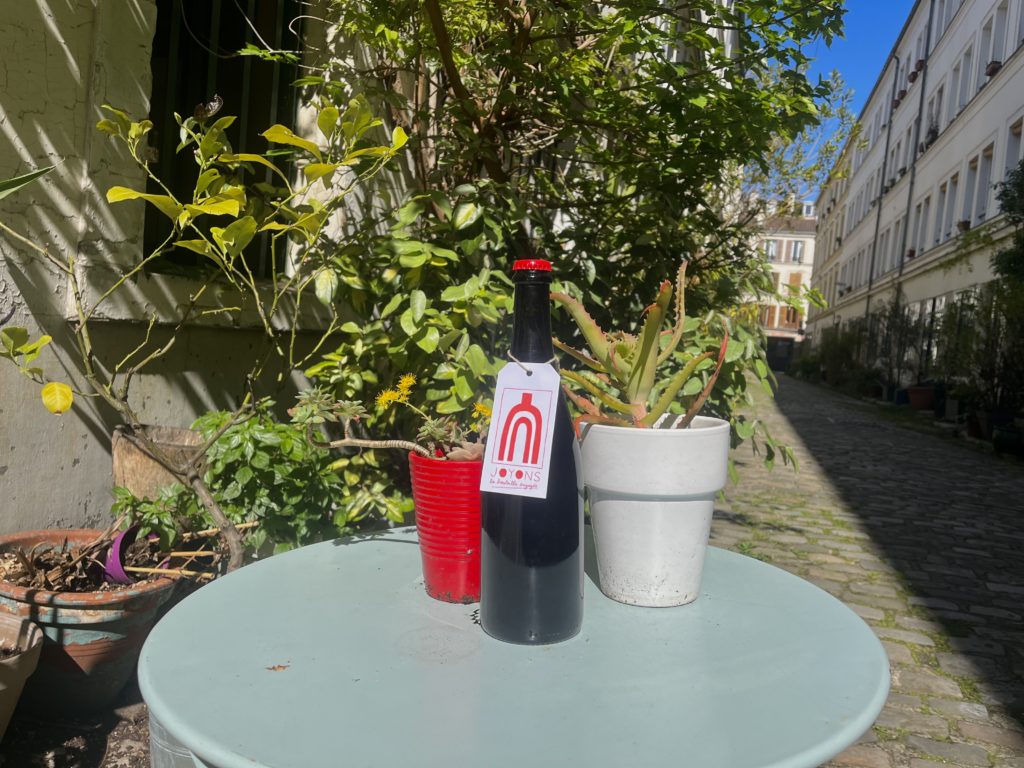
We met Joyons as part of our work supporting the City of Paris in phasing out single-use plastic; the company is among the leading advocates for reuse. Their goal: to transform the management of wine bottles by extending their lifespan, particularly through the reintroduction of a deposit system in the foodservice sector.
Through this model, Joyons is contributing to a profound transformation of the entire wine value chain, from production to consumption.
This interview is also part of a series of podcasts and articles dedicated to the wine industry, with the aim of exploring every stage — from vineyard to table — by giving a voice to winemakers, restaurateurs, and intermediaries, whose role is crucial in this transition.
A project born from a chance encounter
A native of the Basque Country, Marc Etcheberrigaray embodies the spirit of Joyons. His career path, far from linear, began in sports education before branching out into the restaurant industry and then viticulture.
It was while working at the Yes We Camp association, where he served as food coordinator, that the idea for the project took shape. While working on supplier relationships and the issue of fair pricing, he began a line of thinking that quickly took shape. During a festival dedicated to sustainable food, a first experiment was launched: a vintage was bottled on-site, in collaboration with winemakers.
It was around this experience — and a shared bottle — that Joyons truly took shape. Four committed individuals then pooled their expertise: Samuel and Martial Arnaud, winemakers at Ferme des Arnaud, for production; Amaury Boussard, a Paris-based distributor at Iroma, for marketing; and Marc, to champion a vision centered on usage and consumers.
The name “Joyons” reflects this philosophy: sharing, celebrating, and building connections around wine.
The environmental challenge of glass
One figure sums up the issue: glass alone accounts for 40 to 50 % of the wine industry’s CO₂ emissions.
Some partners, such as Ferme des Arnaud in Vaucluse — which has been committed to organic farming since 1978 — have found that nearly half of their carbon footprint stems from wine management (packaging, transportation, waste). This counterintuitive finding places the bottle at the heart of the transition’s challenges.
Deposit-return systems seem like an obvious solution, but their implementation faces cultural barriers. For decades, winemakers have differentiated their bottles to assert their identity.
In response, Joyons has chosen standardization, opting for Champagne-style bottles, which are heavier but also more durable. A bottle can be reused up to 80 times, thereby avoiding the production of new containers and saving up to 1,370 liters of water per wash cycle.
A completely redesigned production chain
The model is based on a multi-step process:
- Production: Winemakers produce the wine on their own estates.
- Transport: The wine is transported in bulk to Paris in tanks ranging from 300 to 1,000 liters.
- Bottling: This is done both locally, in the warehouses in Montreuil, using standardized bottles owned by the cooperative; but it can also take place directly at points of consumption (festivals, events, restaurants), through activities that not only raise consumer awareness of the profession but also foster connections between producers and consumers.
- Labeling: The bottles are labeled under the Joyons brand by their partner Les Ailes Déployées, which also supports people experiencing mental health challenges—adding a strong social dimension to the project.
- Distribution & Collection: Bottles are delivered to restaurants (via traditional truck delivery with Iroma or cargo bike delivery with Cargonautes), then collected once empty, washed, and put back into circulation.
In 2025, nearly 30,000 bottles — divided into 4 categories : red, white, rosé, and naturally sparkling wine — were distributed through a network of 6 winemakers located in the Southwest, the Loire Valley, and the Southeast, with a return rate ranging from 85% to 92%.
A cooperative working for the common good
The project is based on an SCIC-type cooperative model1,1 in which each member has one vote, regardless of their financial contribution. Joyons is also structured as a nonprofit organization, a key decision aimed at building a relationship of trust with its partners.
The cooperative currently has about ten members and remains open to new members, provided they meet certain criteria, including a commitment to organic farming and active participation in the initiative.
Towards a sustainable transformation of the wine industry
For Marc, the transformation of the wine industry is already underway. Between changing consumer habits, declining consumption, and a regulatory framework that is increasingly supportive of deposit-return systems, the landscape is gradually shifting — even in a demanding sector like wine.
Admittedly, cultural resistance remains, as certain innovations — such as capsules, which are more effective than corks at limiting oxidation — are still taking time to gain traction. But for him, these obstacles are not insurmountable, especially if incentive mechanisms are put in place to support the movement.
Resolutely optimistic, Marc believes in a shift in the medium term: one in which reuse will become the norm, fully integrated into the practices of the entire industry. Through this momentum, Joyons goes beyond the simple framework of an innovative circular initiative and is gradually establishing itself as an agent of change, championing a sustainable, collective vision deeply rooted in the challenges of tomorrow.
Learn more
If this topic interests you and you’d like to listen to the full conversation between Justine and Marc, check out the Radio Circulab podcast, available on all streaming platforms (only in French)!
- SCIC: Cooperative Society of Collective Interest ↩︎