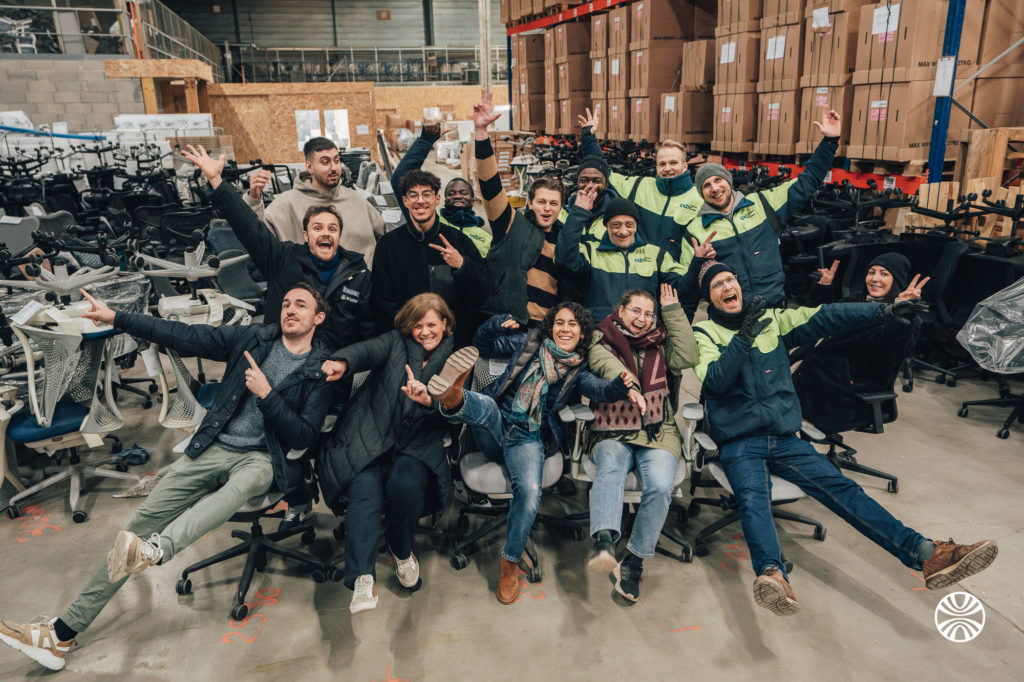
This article is brought to you by adopte un bureau, an innovative player in the professional furniture market. Founded by Christophe Côte, the company pursues an approach that is at once economic, ecological, and social — rethinking the way businesses equip their workspaces.
The concept is simple but powerful: giving office furniture a second life. Rather than systematically buying new, adopte un bureau offers reuse solutions that allow companies to furnish their spaces at lower cost while reducing their environmental footprint. This approach is fully aligned with the circular economy movement, which has become a key priority for organizations today.
Designing responsible, flexible, and lasting professional environments
Workspaces are evolving rapidly — flex offices, remote work, frequent reorganizations. In this context, companies are looking for furnishing solutions that are simultaneously adaptable, sustainable, and aligned with their CSR commitments. Bio-based materials, modular furniture, circular economy: what options are available today?
This article offers a comprehensive overview of concrete solutions available to organizations seeking to balance operational performance with environmental responsibility — and to go further, resources like the adopte un bureau platform can help you take action.
Why rethink the materials used in office furnishing?
The environmental impact of conventional office furniture
Standard office furniture is typically made from virgin raw materials — formaldehyde-based particle boards, petrochemical plastics, non-recyclable synthetic foams. Its lifespan is short: in France, companies replace their furniture on average every 5 to 7 years, generating considerable volumes of waste. According to ADEME, the services sector accounts for a significant share of non-hazardous business waste, with furniture representing a growing fraction.
Add to this an often invisible carbon footprint: intercontinental shipping, energy-intensive manufacturing processes, chemical surface treatments. The environmental cost of “low-cost” furniture is actually far higher than it appears.
New regulatory and normative requirements (Omnibus, ISO 14001, certifications…)
European regulation is pushing companies to structure their environmental approach. The Omnibus, which came into force in March 2026, requires certain categories of organizations to publish detailed sustainability reports, including their impacts on natural resources and waste.
In parallel, voluntary frameworks such as ISO 14001 (environmental management), Cradle to Cradle certifications, and European ecolabels (EU Ecolabel) allow companies to structure and demonstrate their responsible purchasing. Furniture is no exception: both public and private buyers are now integrating environmental criteria into their procurement processes.
The expectations of CSR-committed companies
Beyond legal obligations, companies genuinely engaged in CSR seek to align their everyday practices with their stated values. The workspace sends a strong signal: it says something about an organization’s culture.
Choosing durable, modular, and circular economy furniture is also an act of internal communication (aligning words with actions), talent attraction (younger generations are sensitive to these commitments), and economic resilience (buying better to buy less often).
Sustainable materials: a panorama of available solutions
Certified wood, bamboo, cork: natural and renewable materials
Wood remains the benchmark sustainable material for interior design. FSC (Forest Stewardship Council) or PEFC certified, it guarantees responsible, traceable, and socially equitable forest management. Oak, beech, or local pine offer high structural durability and a timeless aesthetic particularly appreciated in contemporary workspaces.
Bamboo — technically a grass — grows without pesticides and regenerates in 3 to 5 years, compared to 30 to 80 years for an oak tree. Its mechanical strength makes it an excellent wood substitute for desk surfaces, partitions, and storage units. Cork, meanwhile, offers remarkable insulating and acoustic properties, ideal for focus spaces or individual pods.
Recycled and upcycled materials: making the most of existing resources
Applying the circular economy to office furniture starts with looking at what already exists. Recycled materials — post-consumer recycled plastics, recycled textile fibers, recycled aluminum — allow new furniture to be manufactured with a lower environmental impact.
Upcycling transforms end-of-life materials or objects into higher-value products. Advertising banners repurposed as seating, European pallets reworked into shelving, industrial crates transformed into desk pedestals… These approaches create unique pieces with a strong identity, while drastically reducing the need for virgin raw materials.
Platforms like adopte un bureau facilitate this reuse economy by connecting companies that have office furniture to give away with those looking for it — avoiding significant waste and delivering real savings on furnishing budgets.
Bio-based materials: performance with a low carbon footprint
Bio-based materials are derived from plant or animal biomass: linen, hemp, wool, straw, miscanthus… Long confined to the construction sector, they are now making their way into furniture and interior design.
A linen fiber panel, for example, has a carbon footprint up to five times lower than a conventional MDF panel, with comparable mechanical performance. These materials store carbon during their growth phase, are often compostable at end of life, and support local agricultural supply chains — a significant logistical and regional advantage.
Key criteria for assessing material sustainability (LCA, ecolabels, traceability)
To navigate the wide range of available options, objective evaluation criteria are essential:
- Life Cycle Assessment (LCA) measures the environmental impact of a material or product from manufacture to end of life. It enables comparison of seemingly similar solutions based on standardized, quantified data. Ecolabels (EU Ecolabel, GREENGUARD, Indoor Advantage) certify the environmental and health performance of products — notably the absence of volatile organic compounds (VOCs) harmful to indoor air quality.
- Raw material traceability guarantees the origin and production conditions of the components used. Furniture that is transparent about its supply chain is a mark of seriousness and alignment with non-financial reporting requirements.
Modular furniture: agility in service of sustainability
What is modular furniture and why does it change everything?
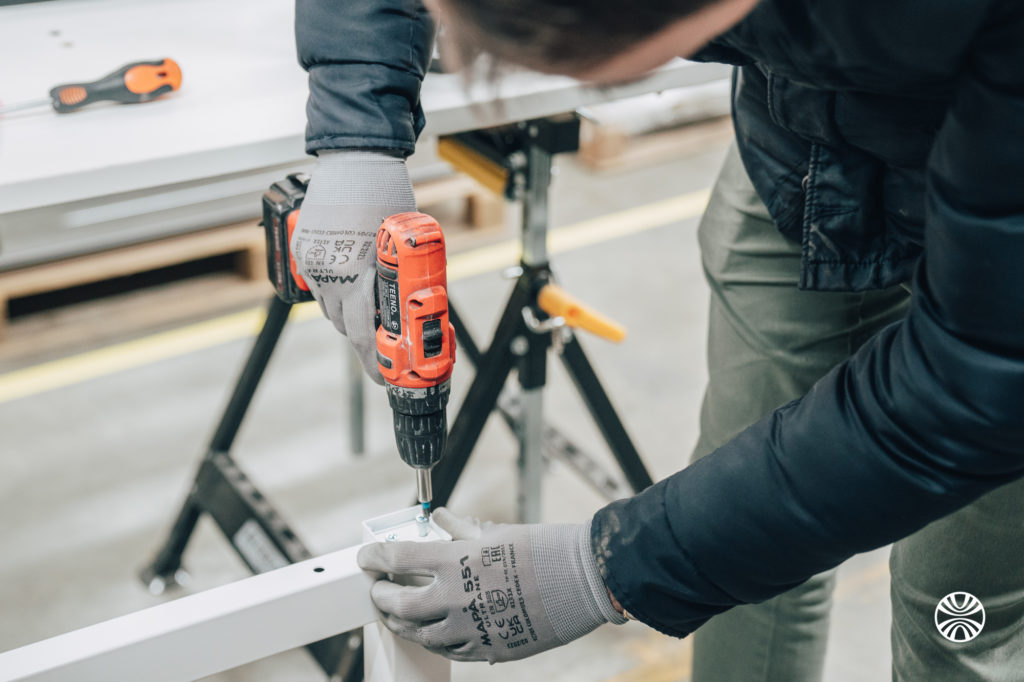
Modular furniture is designed to be assembled, disassembled, reconfigured, and reused according to need. Unlike fixed or custom-built furniture, it is not tied to a specific space or use: it adapts.
This design philosophy fundamentally changes the relationship with the office. You no longer “decorate” a space, you configure it. A collaboration area can become a training room, then an open-plan office, with no construction work, no waste, no hidden costs. For growing companies, those undergoing restructuring, or simply those seeking flexibility, modular furniture is a structural response to a shifting reality.
Adapting spaces without throwing everything away: the promise of modularity
The vast majority of fit-out projects generate waste: furniture bought new for a particular space becomes unsuitable two years later after a reorganization. Modular furniture breaks with this all-or-nothing logic.
Thanks to standardized assembly systems, the same kit of panels and structures can be rearranged in a few hours to create a new configuration. Companies thus save on purchasing, construction work, and disposal costs for obsolete furniture. It is a sustainable investment, in the most literal sense.
Reusability and second life: modular furniture already thinks about what comes next
Well-designed furniture incorporates its own end of life from the outset. Modular furniture facilitates piece-by-piece disassembly, making it possible to resell or donate still-functional components, replace only damaged elements, and recover materials at end of life.
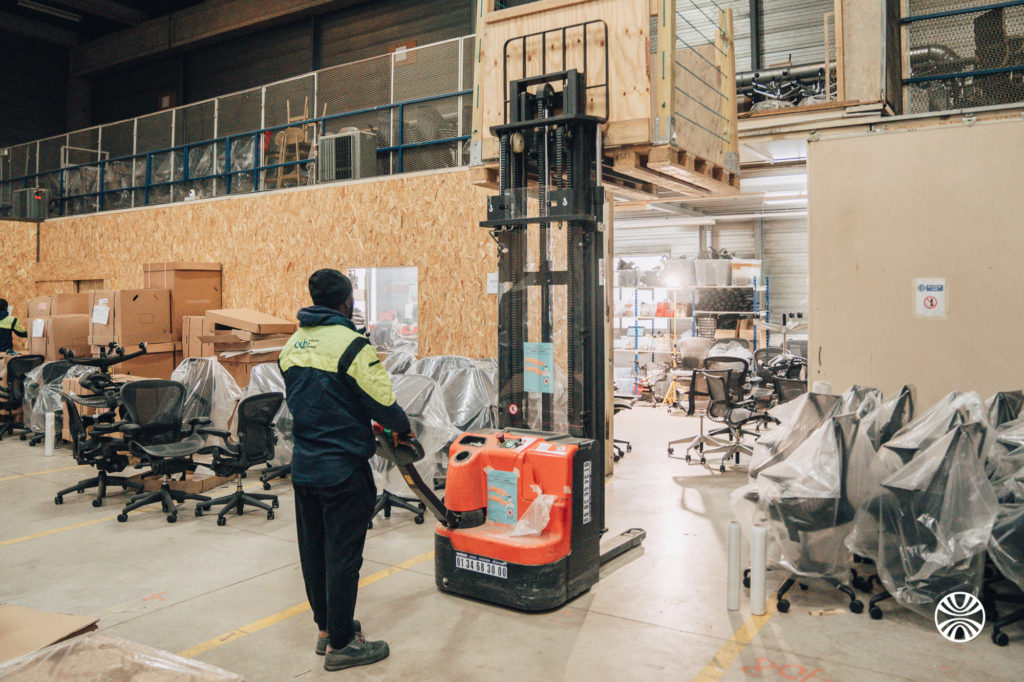
Players like adopte un bureau fit precisely into this logic: they facilitate the reuse of professional furniture by creating a fluid and accessible second-hand market. Buying refurbished modular furniture from such a platform compounds the benefits: controlled budget, reduced carbon footprint, and support for the circular economy.
Concrete examples of successful modular workspaces
Many pioneering companies have already taken the plunge, with compelling results:
- A Paris-based consulting firm reconfigured its 4,300 sq ft workspace three times in two years without any construction work, thanks to a system of mobile partitions and quick-assembly furniture — saving over €80,000 in renovation costs.
- A Lyon-based startup fully furnished its offices with refurbished furniture acquired through a reuse platform, reducing its fit-out budget by 60% and significantly cutting its carbon footprint.
- A public authority opted for certified modular furniture to equip its new meeting rooms, with configurations that can be rearranged in under an hour depending on the intended use.
These examples illustrate that sustainability and operational performance are not contradictory objectives — they reinforce each other.
How to take action in your organization
Where to start: assessment, budget, priorities
Before any purchase or fit-out project, an audit of the existing situation is essential. This means inventorying the furniture in place, assessing its condition, identifying actual space usage, and uncovering unmet needs. This diagnostic prevents impulsive purchasing and directs investment where it will have the greatest impact.
On the budget side, it is useful to distinguish between initial costs (furniture purchase) and total cost of ownership (maintenance, replacement, disposal). Durable, modular furniture may seem more expensive upfront, but its cost over 10 years is generally far lower than that of low-end furniture replaced multiple times. Incorporating refurbished or reused furniture into the planning process can also significantly reduce the entry price.
Integrating sustainability criteria into procurement and furniture purchasing
For organizations subject to public procurement rules or with formalized purchasing processes, integrating environmental criteria into specifications is now both possible and often encouraged by regulation.
In practice, this can include: requiring an ecolabel or environmental certification on products, weighting criteria related to lifespan and modularity, factoring in supplier proximity to reduce logistical impact, and including a take-back or reuse clause at the end of the contract.
Raising awareness among teams and decision-makers
Changing practices around workspace design requires buy-in at every level: senior management, finance, HR, and operational teams. Resistance to change is often rooted in a lack of awareness of available solutions or a mistaken perception of the supposed additional cost.
Awareness workshops, visits to inspiring workspaces, or dedicated support can help remove these barriers. The goal: making sustainable fit-out not a constraint, but a lever for organizational engagement and innovation.
Sustainable and modular workspaces: a profitable and responsible investment
Rethinking the materials and modularity of office furniture is not simply a gesture for the planet — it is a strategic and economically rational decision. Reducing renewal costs, gaining flexibility, showcasing your CSR approach to stakeholders, and making a tangible contribution to the circular economy: the benefits are multiple and measurable.
In a context where regulatory requirements are tightening and employee expectations are evolving, companies that anticipate these transformations gain a genuine competitive advantage. Sustainable fit-out is no longer an option reserved for the most committed organizations — it is a deep-rooted trend redefining market standards.
The circular economy applied to the office is also an opportunity to create spaces that are more human, more beautiful, more coherent — work environments that tell a story and make people want to return.
Take action today
Want to transform your workspace in a sustainable and intelligent way?
Adopte un bureau champions a responsible vision of work. By offering modular and flexible environments — adjustable desks, reconfigurable collaborative spaces, hybrid zones — it supports the transformation of professional practices, including remote work and project-based organizations.
By combining innovation, sustainability, and adaptability, adopte un bureau perfectly illustrates the current shift in the professional furniture market, where economic performance and environmental responsibility are no longer opposed, but complementary.
Explore the adopte un bureau platform to find refurbished, modular, and reused professional furniture — and give a second life to pieces that still have a great deal to offer.
Photo credits: adopte un bureau