There are changes in the private performing arts sector!
On Monday, March 30, 2026, Ekhoscènes (the national union for the private performing arts) hosted the first stakeholder conference for the M.A.T.R.I.C.E. project (Contemporary Music on Tour: Research and Innovation for Cooperation and Eco-design).
This project, initiated and led by Ekhoscènes in partnership with five of its members, aims to re-examine current practices in order to experiment with new ways of producing shows: more collaborative, eco-friendly, and sustainable. This meeting brought together more than 250 industry professionals with the goal of envisioning the future of live performance.
Among the many case studies and initiatives presented during the day, we have chosen to share three particularly inspiring ones with you…
Theater sets that can finally be reused
Traditionally, theater sets rely on structures custom-built for each project. On stage, there are both structural and decorative elements (the latter attached to the former), with the structural elements being automatically dismantled once performances are over — despite their significant potential for reuse.
In response to this situation, several major institutions — including the Théâtre du Châtelet, the Festival d’Aix-en-Provence, the Paris Opera, the Lyon Opera, and the Théâtre de la Monnaie — launched the Collectif 17h25 in 2022. Their goal: to design modular, reusable structures. After several phases of experimentation, the collective developed a standardized system called MOD 200 (inspired by the Lego model) composed of perforated steel elements that allow for flexible assembly.
This innovation could bring about lasting change in the sector by reducing waste, optimizing costs, and fostering new forms of cooperation between venues. True to a philosophy of open dissemination, the collective has chosen to share its progress (the plans are freely available) to encourage adoption by other stakeholders.
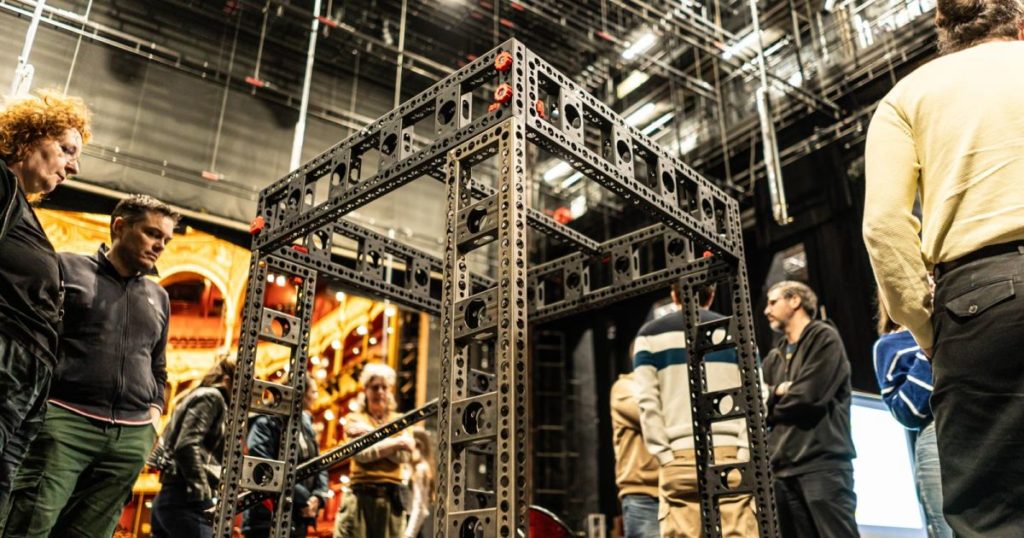
Source : The Monnaie/The Munt website.
The rise of cultural resource centers
Another driver of change is the growth of cultural resource centers. Since its creation in 2020, RESSAC (Network of Artistic and Cultural Resource Centers) now brings together more than twenty organizations across mainland France and its overseas territories. These resource centers, often initiated by performing arts professionals, operate within a circular economy framework. They collect, pool, and recirculate sets, materials, and technical equipment, thereby limiting the waste inherent in short-lived productions.
In this approach, recycling is seen as a last resort: priority is given to reuse and extending the lifespan of collected objects and materials. Beyond resource management, these initiatives contribute to a deeper evolution in artistic practices, as they encourage the integration of environmental impact and end-of-life considerations right from the design phase of works. A new paradigm is thus emerging, made possible by the sector’s ability to plan for the repurposing of sets right from the design phase!
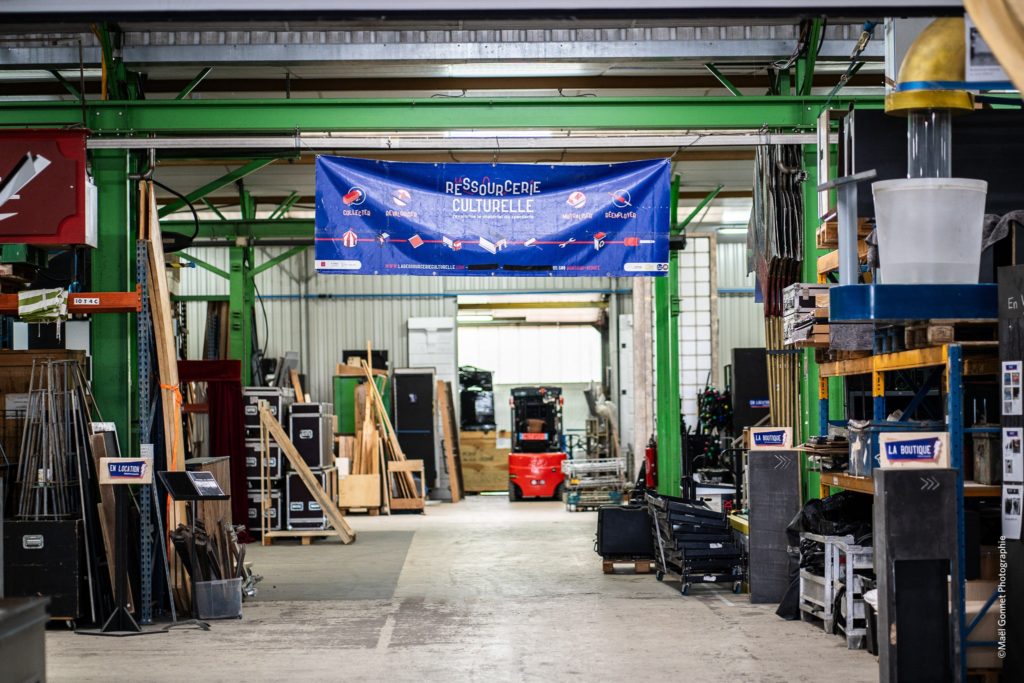
Source : Website of the Cultural Resource Center of Montaigu.
Offering and consolidating solutions at the regional level
The association Les Augures demonstrates how the sector can transform itself on a large scale. Through a collaborative lab, it has developed tools to support the ecological transition of the performing arts.
Among these is the “eco-library” an open-source directory organized by region that lists stakeholders engaged in the circular economy: reuse, sharing, transportation, and eco-design. The idea? To highlight existing initiatives and create local synergies throughout the entire production chain. To complement this tool, project sheets and practical guides enable organizations to adopt these solutions and adapt them to their specific needs.
The challenge now is to continue expanding these databases and extending these initiatives, particularly in the field of contemporary music, so that the transformation becomes collective and operational.
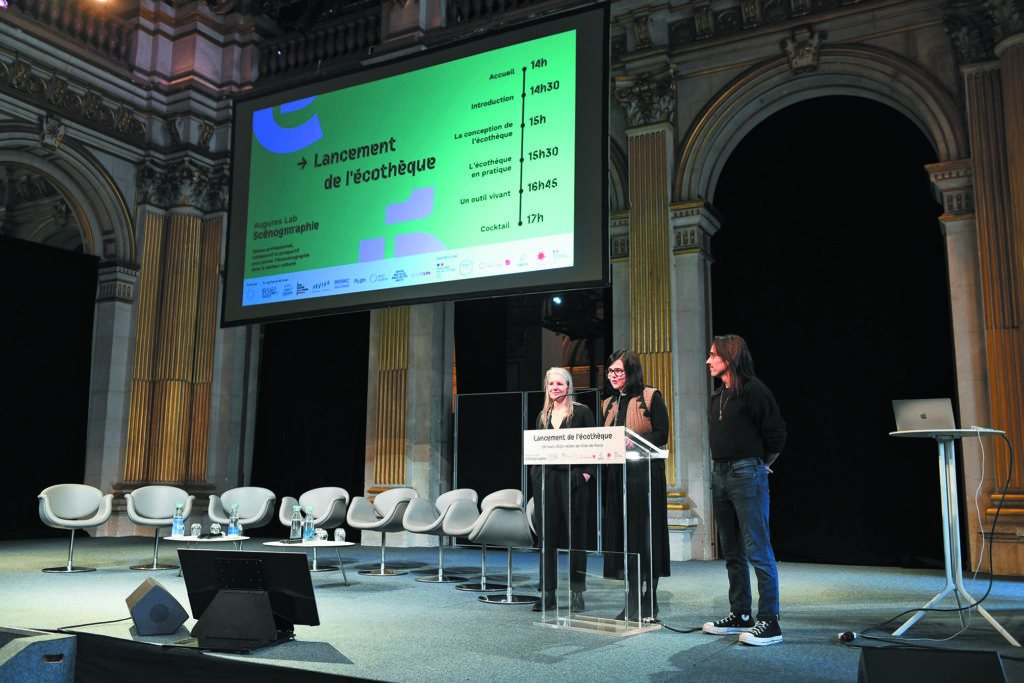
Launch event for the collaborative platform “l’écothèque,” organized by Augures Lab Scénogrrrraphie. Source: Website of the Revue de la Scénographie.
Conclusion
Through these initiatives (and many others), the performing arts seem to be entering a new era. More than just an adaptation, a structural transformation is taking place, driven by a collective awareness. We are only at the beginning; stakeholders in the private performing arts sector are continuing their efforts and will meet again in June for the second convention to continue the dialogue and further explore these experiments!
Learn more
If this topic interests you and you’d like to explore it further, check out the Radio Circulab podcast, available on all streaming platforms!