Each year, Europe generates more than 10 million tons of electronic waste — nearly 20 kg per capita — making it the world’s largest producer of WEEE (Waste Electrical and Electronic Equipment) per capita, according to The Global E-waste Monitor 2024. Behind these considerable volumes, however, lies a potential that remains largely untapped: the reuse and repurposing of electronic equipment before it is recycled or discarded.
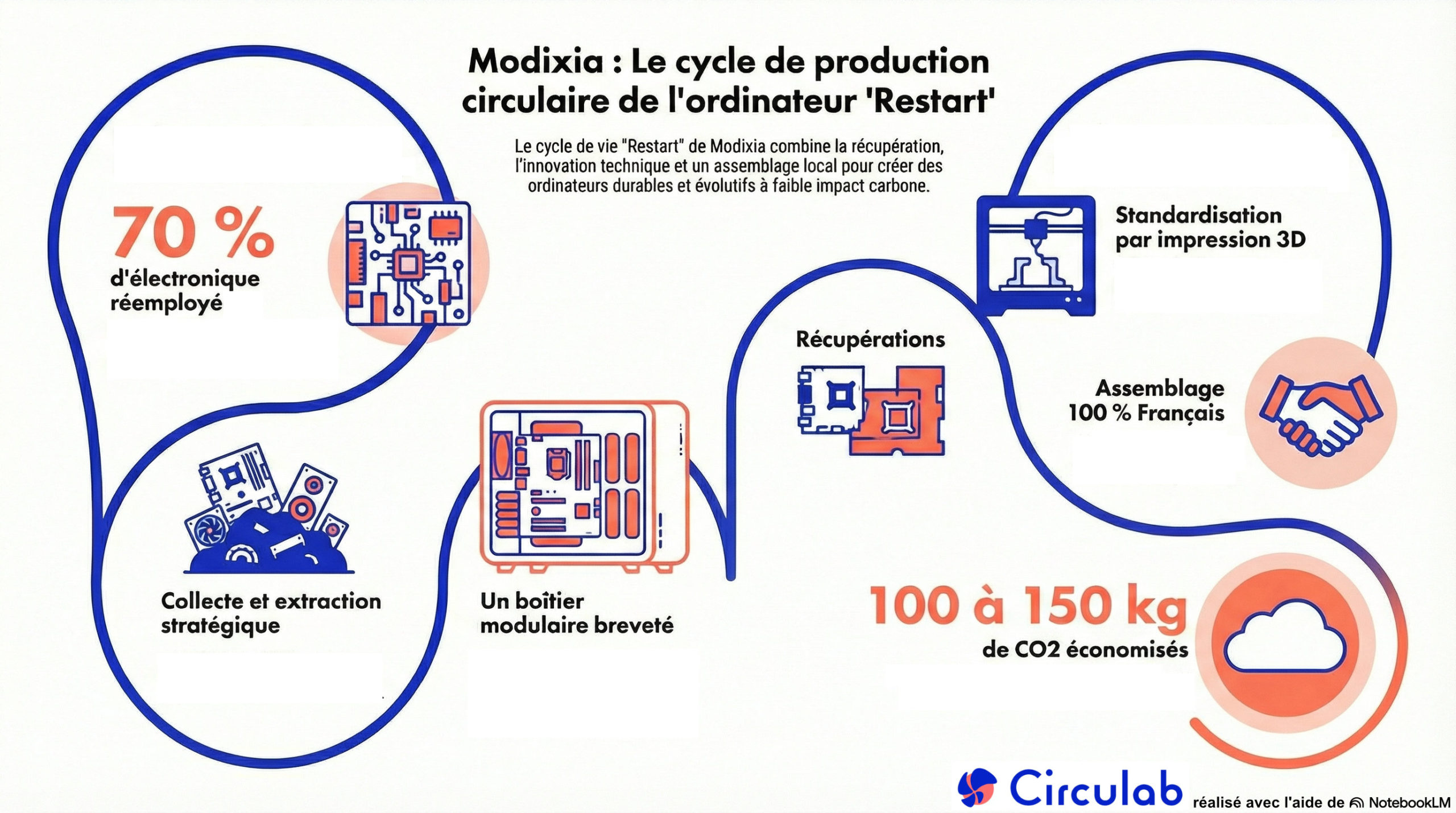
Modixia’s starting point is based on a very concrete observation: many laptops are discarded for purely mechanical reasons, such as defective hinges, even though their internal components (motherboards, processors, memory, etc.) remain fully functional. This phenomenon leads to significant waste of components with a high carbon footprint.
Faced with this situation, founder Jérôme Botte chose to go beyond the limits of traditional refurbishment by focusing on the reuse of parts and the circular economy. Modixia has thus developed a specific expertise: transforming non-refurbishable laptops into desktop computers designed to be modular, high-performance, and durable.
It is on this approach that Modixia was built — a French company offering a circular alternative to traditional business computing.
Tapping into the resource pool: a key challenge for reuse
While the resource pool certainly exists — “everyone has a computer these days,” notes Jérôme Botte — the real challenge lies in tapping into it.
In its early days, Modixia relied on resources accessible through platforms like Leboncoin, for example, and then embarked on scaling up the model. This strategy proved particularly effective during the Covid-19 crisis, when the global industry was facing shortages of components and semiconductors, as Modixia already had stocks of reusable parts, ensuring production continuity where new production had come to a standstill.
A product designed to last (for real)
Rather than relying on recycling (which remains largely energy-intensive and polluting), Modixia has opted for reuse by developing a modular chassis designed to adapt to technological advancements and users’ actual needs. Computers can thus be upgraded in a targeted manner, replacing only the necessary components (memory, motherboard, storage) without having to replace the entire machine. This approach reduces the carbon footprint by up to 80% compared to purchasing a new computer.
Modixia’s model is thus based on the sale of modular central processing units with a lifetime warranty, complemented by upgrade services throughout the product’s lifespan. A Restart central processing unit is available for around €480 (excluding tax). While this price may be slightly higher than that of a standard desktop tower, it is justified by French manufacturing, extensive refurbishment, and a lifetime warranty. In the long term, this approach reduces overall costs while contributing to technological sovereignty and the development of the local economy. This resilience model is thus directly aligned with a circular economy approach applied to electronics.
Committed public sector clients
Modixia’s main clients today are local governments. Libraries, public institutions, and educational facilities: these are all places where the environmental and social impact of IT equipment has become a key consideration. “I like to think that when my daughter goes to the library, she’s using Modixia computers,” says Jérôme Botte
In conclusion
In a world where digital technology is everywhere, Modixia demonstrates that it is possible to do more with less by radically rethinking the way we design, use, and extend the lifespan of our computers.
If this topic interests you, feel free to listen to the Radio Circulab podcast on your favorite streaming platform.
Note :